Surnames of Hillsborough County
Surnames that I have been researching are the Buzbee, Swilley, Hewett,
in Hillsborough County, Florida. The Coker family out of Taylor County, Florida. I am also researching the Pitts, Rooks, Haman families out of Worth, Irwin and Dooly County, Georgia.
BUZBEE
By the 8th Century the Danes had begun to settle in Northumbria and East Anglia in the Northwest of England. They were of the same original stock as the Angles who had settled in England (Angle-land) centuries prior. They came from the area which we now identify as Schleswig and the home of the Danes was the island of Zealand. Place names in Yorkshire are largely Scandinavian.
Almost 200 place names ending in ‘by’ can be found there, several of which are called Busby or Bushby. Among the many spellings of this name are Busbee, Busbey, Bushby, Busby and Buzbee…These names developed in England quite early from two commonly used words ‘busc’ and ‘byge’.
The former was the word which described a bush; ‘byge’ or the Danish form of the ‘by’ originally meant a single house, then came to be employed for a group of houses or even a village. Thus Busby originally was a description given to a person who may have lived by an unusual grove of shrubbery, recorded as ‘Bushcbye.’
Ancient records show the first written documents employing the name in the year 1273. John Bussebe is listed as landowner and required to pay a hearth tax.
Richard Busby, born in 1606 was an English clergyman, headmaster of Westminster School at which his reputation was great. He once boasted that he had birched (whipped) at least 16 bishops when they were his pupils. There is an effigy of this man at Westminster Abbey where he is buried.
Busby is also the name of a British military headdress. The original sense of the Busby-wig probably came from the association with Dr. Busby of Westminister, but it is also derived from the Hungarian form which was cylindrical, made of fur with a cloth hanging from the top. The end of the bag was attached to the shoulder as a defense against sword thrusts.
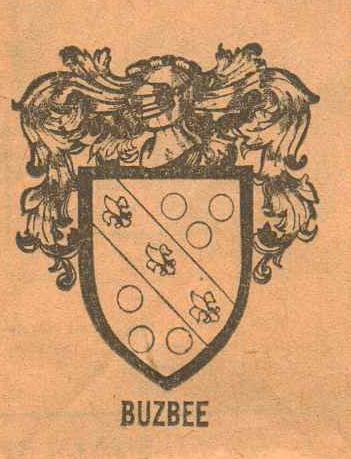
One of the more impressive coats of arms on record for the Busby (Buzbee) name is “Gules, on a bend argent, between six bezants, three fleue de lis azure.” The background of the shield is colored red (gules) with a diagonal band of silver (argent) on which there appears three fleur de lis of blue (azure). On the field of the shield are six bezants which are circular gold coins said to represent Byzantine coins acquired on the Crusades.
These would be incorporated onto the shield by knights as an indication of their travels and pilgrimages to the Eastern lands.
PITTS
The distinguished surname Pitts emerged among the industrious people of Flanders, which was an important trading partner and political ally of Britain during the Middle Ages. As a result of the frequent commercial intercourse between the Flemish and English nations, many Flemish migrants settled in Britain. In early times, people were known by only a single name. However, as the population grew and people traveled further afield, it became increasingly necessary to assume an additional name to differentiate between bearers of the same personal name. The manner in which hereditary surnames arose is interesting. Local surnames are derived from where the original bearer lived, was born, or held land. Flemish surnames of this type frequently are prefixed by de la or de le, which mean of the or from the . The Pitts family originally lived in the settlement of Pett in Kent, in the place named Pitt in Hampshire, or in any low-lying area resembling a pit or hollows. The surname Pitts is derived from the Old English words pytt, which means pit. Pitts belongs to both the category of habitation names, which are derived from pre-existing names for towns, villages, parishes, or farmsteads, or other places, and the class of topographic surnames, which were given to people who resided near physical features such as hills, streams, churches, or types of trees.
Flemish surnames are characterized by a large number of spelling variations. One reason for this is that medieval English lacked definite spelling rules. The spellings of surnames were also influenced by the official court languages, which were French and Latin. Names were rarely spelled consistently in medieval times. Scribes and church officials recorded names as they sounded, rather than adhering to specific spelling rules, and people often had their names registered in several different forms throughout their lives. One of the greatest reasons for change is the linguistic uniqueness of the Flemish settlers in England, who spoke a language closely related to Dutch. The pronunciation and spelling of Flemish names were often altered to suit the tastes of English-speaking people. In many cases, the first, final, or middle syllables of surnames were eliminated. The name has been spelled Pitt, Pit and others. First found in Devon where they held a family seat from early times. The first record of this family appeared on the early census rolls taken by the Kings of Britain to determine taxation rates for their subjects.
John Richard Pitts and Retha Mahala Haman were both born in Georgia. John Richard Pitts being the son of Charles Anderson Pitts and Myra Louise Story. Retha Mahala Haman was the daughter of Alva Pinkney Haman and Mary Matilda Rooks. They moved to the Hillsborough County, Florida area after 1940 but was living in Florida after 1920.

HEWETT
Norman surnames are characterized by a multitude of spelling variations. The frequent changes in surnames are largely due to the fact that the Old and Middle English languages lacked definite spelling rules. The introduction of Norman French to England, as well as the official court languages of Latin and French, also had pronounced influences on the spelling of surnames. Since medieval scribes and church officials recorded names as they sounded, rather than adhering to any specific spelling rules, it was common to find the same individual referred to with different spellings. The name has been spelled Hewitt, Hewett, Hewatt, Hewet, Hewit, Hewat and others. First found in Dorset where they held a family seat from very early times and were granted lands by Duke William of Normandy, their liege Lord, for their distinguished assistance at the Battle of Hastings in 1066 A.D.
Henry Moses Hewett is found in Hillsborough County, Florida in 1870, he married Virginia Swilley, daughter of Thomas and Eliza Coker Swilley. They had two children: Annie Belle Hewett and William Henry Hewett. William Henry Hewett was killed in 1926 in shooting by the Sheriff of the county. Annie Belle Hewett married James Corbett Buzbee of Hillsborough County, Florida.
COKER
The Anglo-Saxon name Coker comes from the family having resided in Somerset, where they lived in one of two parishes named Coker. Coker has been spelled many different ways. Before English spelling became standardized over the last few hundred years, spelling variations in names were a common occurrence. As the English language changed in the Middle Ages, absorbing pieces of Latin and French, as well as other languages, the spelling of people’s names also changed considerably, even over a single lifetime. Coker, Coaker, Cokers and others. First found in Somerset where there is an East, and West Coker. North Coker no longer exists. The place name dates back to at least the Domesday Book where it was listed as Cocre, part of the Houdsborough hundred and was originally the name of a stream there, a Celtic river-name meaning “crooked, winding.” East Coker was the second poem of T. S. Eliot’s Four Quartets and was directly connected to Eliot’s ancestry and East Coker’s church was later to house Eliot’s ashes.
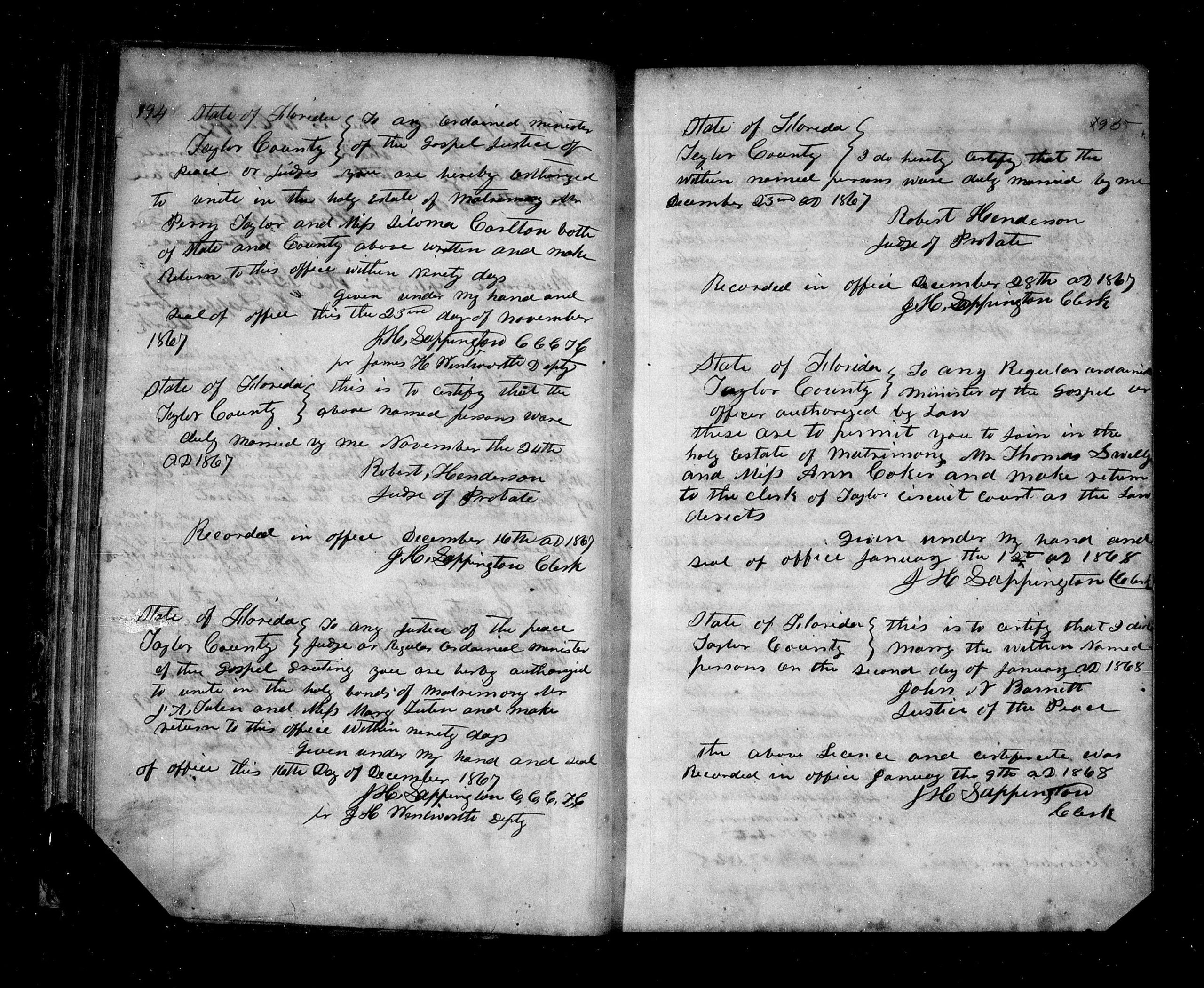
Thomas Swilley married Elizabeth Ann Coker in Taylor County, Florida on 2 Jan 1868. I have found a court record for Taylor County, Florida for Thomas and Eliza Swilley showing that they divorced on I do not know how many of Eliza’s children are by Thomas Swilley, as she is listed a widow in 1880 but had twins after 1880 that were named Swilley. Eliza Coker’s children are Hester Ann Swilley, Jane Swilley, Laura Swilley, Charity Swilley, Lucy Swilley(Virginia), Lilly Swilley, Nan Swilley and Robert Swilley.